Space Scholarships: The Best Funding Opportunities for Students
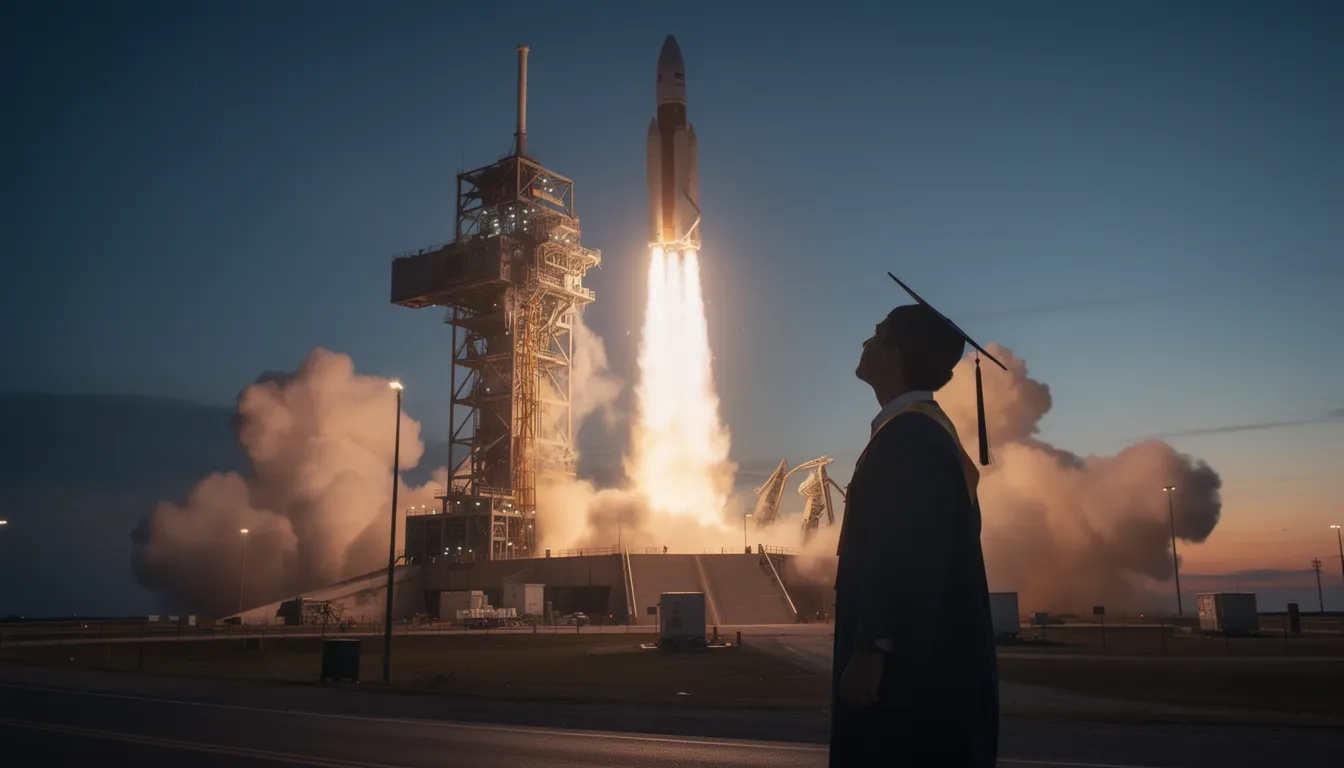
The Space Foundation's 2024 Space Report put global space industry revenue at roughly $630 billion — and analysts expect that to reach $1.8 trillion by 2035. That kind of growth creates a talent gap that no amount of reshuffling engineers from other sectors can fix. Scholarship money is following the demand. If you're a student who wants to work in space, the funding landscape right now is more generous than it has ever been.
Why Space Scholarships Are Multiplying
Ten years ago, "space careers" mostly meant NASA jobs and a handful of defense contractors. Now it's SpaceX, Rocket Lab, Blue Origin, Vast Space, a fleet of satellite startups, and a growing policy apparatus in Washington. The workforce demand has outpaced the pipeline, and schools, foundations, and companies are all trying to fix that by pulling students toward space-related degrees.
The numbers tell the story. The American Institute of Aeronautics and Astronautics (AIAA) now distributes over $225,000 in annual scholarships and STEM grants. The Astronaut Scholarship Foundation, started by the Mercury 7 astronauts in 1984, has awarded over $11 million to science and engineering students since its founding. This isn't charity. It's a calculated bet that the field needs far more people than it's currently producing.
There's also a broader shift happening: space careers no longer belong exclusively to engineers. Lawyers who understand orbital licensing, economists modeling satellite bandwidth markets, biologists studying long-duration spaceflight effects — all of them are needed. Some scholarships have started to reflect that reality.
NASA's 52-State Network: The Most Overlooked Resource
Most students scroll past the NASA National Space Grant College and Fellowship Program because the name sounds bureaucratic. That's a real mistake.
NASA established Space Grant in 1989 as a national network of university-based consortia — one per state, plus Washington D.C., Puerto Rico, and several territories. 52 consortia total, each funded by NASA and tasked with creating direct pathways into aerospace and STEM careers. Every consortium operates through universities in its state, which means the award amounts, deadlines, and eligibility rules vary considerably from one state to another.
The Illinois Space Grant Consortium offers up to 18 scholarships of $3,000 each for the 2026–2027 academic year, with applications opening December 1, 2025. Iowa's program offers eleven $3,000 scholarships for incoming students and eight $5,000 research scholarships for upperclassmen. The point is: your state almost certainly has money sitting there, and the competition is local rather than national.
The Space Grant network is probably the single most underutilized space scholarship resource — not because the awards are small, but because students assume "NASA scholarships" are reserved for top engineering candidates at MIT.
Finding your state's program takes about 90 seconds. The NASA Space Grant site maintains a directory of all 52 consortium directors with links to their individual websites. Start there before looking anywhere else.
Elite Merit Scholarships: High Dollar, High Bar
These are the programs that change résumés.
The Astronaut Scholarship Foundation awards up to $15,000 per year to science and engineering undergraduates who intend to pursue research or advance their field. The Mercury 7 astronauts who founded it wanted to fund people who would push boundaries — not just people with good grades. Nominations for the 2026 scholarship closed March 30, 2026, so the next cycle to target is 2027. The award is nomination-based: your university department nominates you, which means you cannot apply cold.
The AIAA Foundation runs a parallel universe of named awards. The Mary W. Jackson Scholarship ($10,000), the David and Catherine Thompson Space Technology Scholarship ($10,000), and the Daedalus 88 Scholarship ($10,000) all target aerospace-focused students. At the standard undergraduate level, AIAA awards roughly 30 scholarships of $2,000–$2,500 to sophomores, juniors, and seniors annually. Applications open October 15 and close January 31 — a window of about 107 days, which sounds comfortable until December arrives.
| Scholarship | Award | Level | Key Deadline |
|---|---|---|---|
| Astronaut Scholarship Foundation | Up to $15,000 | Undergraduate | March (by nomination) |
| AIAA Named Awards | $10,000 each | Undergrad/Grad | January 31 |
| AIAA Standard Undergraduate | $2,000–$2,500 | Undergraduate | January 31 |
| TEAM-UP Together | $10,000 | Undergraduate | Varies |
| NSSA RGi Scholarship | $10,000 | Undergrad/Grad | March 27 |
| NSSA Moorman Scholarship | $10,000 | Undergraduate | March 27 |
Industry-Backed Programs: Policy, Security, and Commercial Space
Not all space scholarships come from foundations. Some of the best ones come from organizations that have a direct stake in building the workforce.
The Matthew Isakowitz Commercial Space Scholarship is the one I'd point any commercial-space-focused student toward first. Named after Matthew Isakowitz — a federal budget analyst who became one of the most important figures in early commercial spaceflight before his death in 2017 — the program pairs a $1,000 scholarship with an internship placement at a commercial space company. Recent placements include Rocket Lab, Vast Space, Blue Origin, and NASA Headquarters. The deadline for Summer 2026 placements was November 7, 2025 (with final selections in February 2026), so the next cycle to target is Summer 2027.
What makes this scholarship worth noting beyond the dollar amount is the access it provides. Scholars get direct mentorship from executives and policymakers — the kind of network that otherwise takes years to build. For a student in aerospace policy or business, that matters considerably more than the $1,000.
The National Security Space Association (NSSA) offers two $10,000 scholarships with a March 27, 2026 deadline: the RGi Scholarship (open to undergrad and graduate students in STEM with interest in national security space) and the Moorman Scholarship (for undergraduates who demonstrate leadership and community service alongside technical ability). Both require U.S. citizenship. Both are undersubscribed by students who don't actively follow the defense-space world, which makes them less competitive than their dollar value would suggest.
The Space Force Association also runs a scholarship program targeting students pursuing STEM careers connected to space operations, with a recently extended 2026 deadline.
You Don't Have to Be an Engineer
Here's the elephant in the room with most space scholarship lists: they skew heavily toward engineering and physics majors. But the space industry needs much more than engineers.
The TEAM-UP Together Scholarship specifically supports physics and astronomy undergraduates with demonstrated financial need. In the 2025–2026 cycle, it funded 87 students with $10,000 each (run jointly by the American Physical Society and the American Association of Physics Teachers). If you're a physics or astronomy major who doesn't fit the aerospace-engineering mold, this program was built for your situation.
The Interstellar Research Group takes the widest view of any program on this list. Their 2026 scholarships ($2,500 each at the undergraduate, master's, and doctoral levels) explicitly accept applicants in ecology, social sciences, health, law, agriculture, business, and education — not just STEM fields. The reasoning is sound: making humanity a multi-planetary species requires contributions well beyond rocket science. The December 15, 2025 deadline for the 2026 cycle has passed, but applications typically reopen annually.
For astronomy-specific students, the American Astronomical Society maintains a general funding page listing grants, awards, and travel stipends for students at various stages of their training.
How to Build a Competitive Application
Most students who miss out on space scholarships don't lose because of grades. They lose because their applications read as generic.
The essay is where most decisions get made. A student who articulates a specific research interest — say, debris mitigation strategies for low Earth orbit constellations — reads as more compelling than one who writes "I've always been passionate about space." Specificity signals depth. Committees reading 200 applications remember the one that had a real point of view.
Some practical guidance:
- Start with your state's Space Grant Consortium. Local competition is thinner, the award is still meaningful, and winning builds your record for national programs.
- Get on faculty radar early for nomination-based programs. Talk to your department advisor in sophomore year about the Astronaut Scholarship, not junior spring when it's too late.
- Join AIAA as a student member before applying. Membership is free for students and opens the application window for their scholarship programs.
- Track deadlines on a single calendar. The October–March window covers nearly every major space scholarship cycle.
One thing students consistently underestimate: actually engaging with the organizations before applying. Attending an AIAA student chapter event, following NSSA's work, or reading Matthew Isakowitz Foundation publications gives you real things to reference in essays. It signals genuine engagement rather than scholarship tourism.
The Timing Calendar
Most space scholarships cluster into a predictable annual cycle:
- October–November: AIAA applications open; Matthew Isakowitz deadline (for summer internships)
- December–January: Interstellar Research Group deadline; AIAA application window closes
- March: NSSA deadline; Astronaut Scholarship nominations; Space Force Association deadline
- Year-round: State Space Grant programs (check your consortium's specific timeline)
Students who build this calendar in September of their junior year are in a strong position. Students who start searching in February have already missed roughly half the programs on this list.
Bottom Line
The money is out there, and a meaningful portion of it goes unclaimed each cycle — especially at the state Space Grant level where the applicant pool stays local.
- Begin with your state's NASA Space Grant Consortium. It's the most accessible entry point, competition is regional, and awards are often renewable year over year.
- If you're in engineering or physics, target the AIAA Foundation and start building faculty relationships for Astronaut Scholarship nomination well before your senior year.
- If you're in a non-engineering field, TEAM-UP Together and the Interstellar Research Group are specifically designed to fund you — they're not consolation prizes, they're the right fit.
- Build the deadline calendar in September. October through March is when nearly every major application closes. Treating this as spring-of-senior-year work means you've already missed most of the field.
Stop waiting to feel qualified enough. Scholarship committees aren't looking for finished experts. They're looking for students who are clearly pointed in a direction and already moving.
Frequently Asked Questions
Do I need to be a U.S. citizen to apply for space scholarships?
Most major programs — including NASA Space Grant, the Astronaut Scholarship Foundation, AIAA, and NSSA — require U.S. citizenship or permanent residency. The Matthew Isakowitz Scholarship accepts U.S. Person status (citizens, permanent residents, asylees, and refugees). International students should look at institutional scholarships through their university or through discipline-specific associations without citizenship restrictions.
Is it a myth that space scholarships are only for engineering majors?
Largely yes. Programs like the Interstellar Research Group explicitly accept social sciences, law, business, ecology, and education majors. TEAM-UP Together targets physics and astronomy undergrads outside the traditional aerospace path. As the commercial space sector expands into policy, finance, and life sciences, scholarship eligibility is broadening to reflect the actual workforce.
What GPA do I need to be competitive?
There's no universal cutoff, but most merit-based programs like the Astronaut Scholarship and AIAA awards target students near the top of their class. A 3.5 GPA is a reasonable floor for those programs. Some scholarships weight financial need, leadership, or community service more heavily than academic scores — the NSSA Moorman Scholarship is a clear example where character and service matter as much as grades.
How do I find my state's NASA Space Grant program?
Go to the NASA Space Grant program page and use the directory of consortium directors to find your state's lead institution. Each consortium lists which universities in that state participate. Even if your school isn't a member institution, you can often apply through the lead university directly.
Is the Matthew Isakowitz Scholarship worth applying for if the cash award is only $1,000?
The dollar figure undersells it considerably. The real value is the structured internship placement with a commercial space company (recent placements include Rocket Lab and Blue Origin) and direct networking with executives and policymakers. For a student building a commercial space career, those connections routinely translate into job offers and long-term mentorship that outlast the summer placement.
When should I realistically start looking for space scholarships?
Sophomore year is the right time to start. Research which programs require institutional nominations (those require faculty relationships built over time), identify your state's Space Grant Consortium, and join AIAA as a student member. By junior year, you should be actively applying — which means having essays drafted by September so October and November deadlines don't catch you off guard.
Sources
- NASA National Space Grant College and Fellowship Project
- Astronaut Scholarship Foundation
- AIAA Undergraduate Scholarships & Graduate Awards
- Matthew Isakowitz Commercial Space Scholarship
- National Security Space Association Scholarships 2026
- Interstellar Research Group 2026 Scholarships
- Illinois Space Grant Consortium Scholarship Information
- AIAA 2025 Undergraduate Scholarship Winners – Aerospace America