Best Resume Templates for College Students in 2026
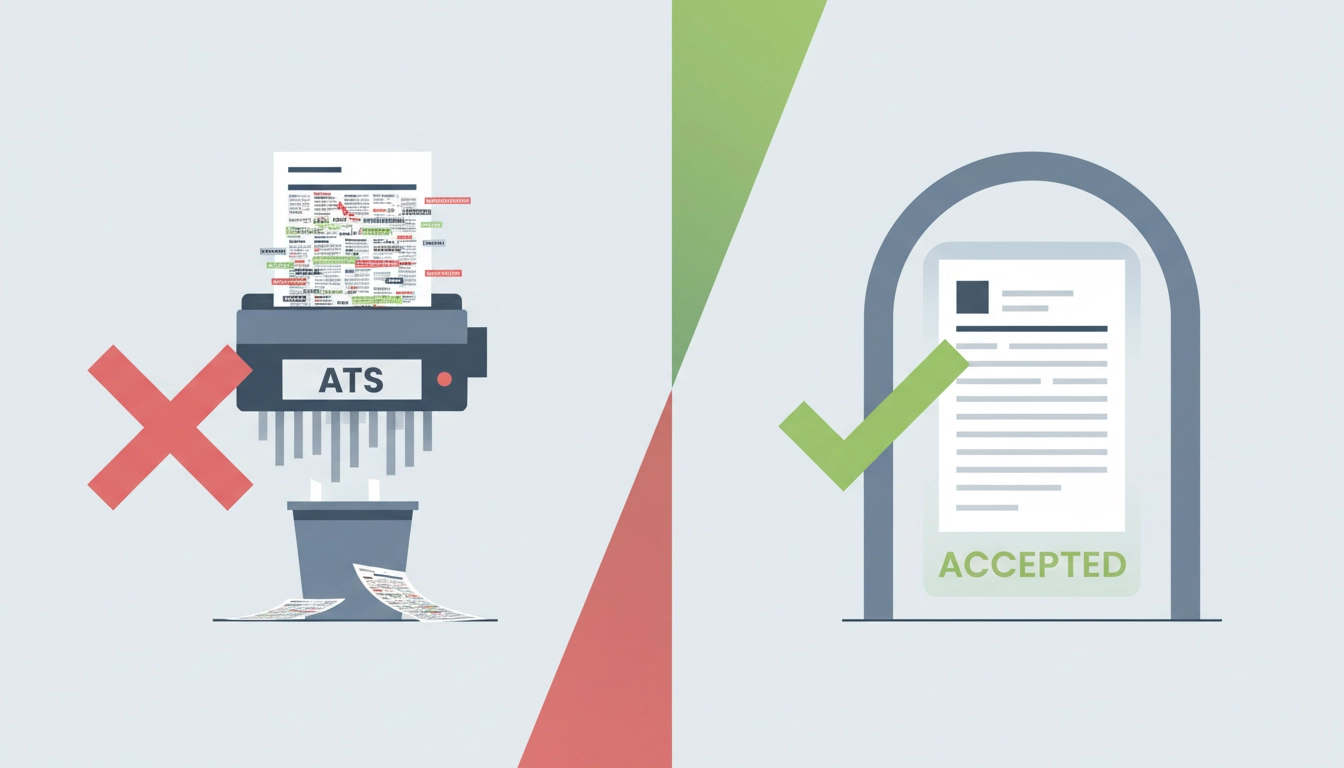
Here's the uncomfortable truth: 75% of resumes are discarded by automated systems before a single human reads them. If you grabbed a template from Canva with a fancy sidebar, skill bars, or a headshot placeholder, there's a real chance no one has seen your application.
That stat comes from data aggregated by Jobscan and Merit America, and it's not just bad luck. It's mostly bad formatting choices. The good news is that college students who get this right tend to stand out fast, because most of their peers don't.
Why Your Template Choice Is Actually a Technical Decision
Most people think picking a resume template is about aesthetics. It isn't, at least not for the first 30 seconds of your application's life.
Applicant Tracking Systems parse your resume like a computer reading a form, scanning for structured data: job titles, dates, skills, education. When you use a two-column layout, a table, or text inside a graphic, the parser gets confused. It scrambles section order, misses content, and drops information.
According to Merit America's 2026 hiring analysis, 91% of employers now use AI tools to screen resumes before a recruiter ever opens the file. NovoResume reports that 82% of recruiters use some form of screening software in their pipeline. So pick your template like you're making a technical decision.
Clean beats clever.
The 5 Template Types and When to Use Each
Different fields have different norms. Here's the actual breakdown:
| Template Type | Best For | ATS-Safe? | Tradeoff |
|---|---|---|---|
| Classic/Reverse-Chrono | Most students, business, finance, law | Yes | Can look plain |
| Modern Single-Column | Marketing, communications, ops | Yes | Needs strong content |
| Creative (Multi-column) | Design, advertising, media | Risky | May fail ATS |
| Skills-Based/Functional | Students with zero work history | Yes | Recruiters distrust it |
| Technical | CS, engineering, data science | Yes | Too sparse for non-tech roles |
My honest take: for 90% of college students, a clean modern single-column template is the right call. It clears ATS filters, looks professional, and works across industries. Save the creative layouts for your portfolio website, not your resume.
The exception is creative fields. If you're applying to a graphic design agency, a multi-column layout signals you understand design. But even then, submit a plain version when the application goes through an online portal.
How to Order Your Sections (It's Different for Students)
On a professional's resume, work experience leads. On a college student's resume, education goes first. This isn't a style choice — it's strategy.
Your degree is your strongest credential right now. Leading with it signals confidence rather than drawing attention to limited job history. Here's the order that works:
- Contact Info + Header — name, email, phone, LinkedIn URL, portfolio or GitHub if relevant
- Resume Objective — 2-3 sentences naming the role and one qualifying achievement
- Education — school, major, graduation date, GPA (only if 3.5+), honors
- Experience — internships, part-time jobs, campus leadership, relevant projects
- Skills — specific software, tools, languages
- Additional — certifications, volunteer work, publications, spoken languages
One wrinkle: if you're in CS or engineering, move Skills up above Experience. Hiring managers for technical roles scan for tech stacks before reading anything else.
Building an Education Section That Does Real Work
Most students list their degree and GPA and call it done. That's leaving opportunity on the table.
Expand your education section with relevant coursework, but describe it as an achievement rather than a course catalog. Instead of "Financial Accounting," write "Financial Accounting: built a full three-statement model for a mock acquisition case." That second version signals both the topic and a concrete skill.
Include academic honors, dean's list appearances, relevant competitions, or thesis topics. If your GPA is below 3.5, leave it off (this is standard practice, not deception). If your major GPA is meaningfully higher than your overall GPA, list both clearly labeled: "Major GPA: 3.7 / Overall GPA: 3.2."
Harvard's Career Services recommends including relevant coursework specifically when it mirrors requirements listed in a job posting. It won't replace experience, but it fills the gap until you have some.
What Counts as Experience When You Don't Have a "Real Job"
Here's something that trips up a lot of students: most things you've done count. The bar is not "paid full-time position."
These all qualify as legitimate experience entries:
- Internships, paid or unpaid
- Part-time retail, food service, or campus jobs
- Club leadership roles (president, treasurer, team captain, RA)
- Freelance projects or commissioned work
- Academic research assistant positions
- Volunteer work with recurring responsibility or measurable output
For each entry, follow this structure: action verb + what you did + how + result. "Managed social media" is weak. "Grew the club's Instagram following from 312 to 1,847 in one semester by posting behind-the-scenes content three times weekly" is strong. Candidates who include metrics in their bullet points see 40% higher response rates than those who don't, according to Merit America's 2026 analysis.
Conservative estimates still count. "Served approximately 50-70 customers daily" is better than no number at all.
Writing Bullet Points That Get Past Both the Screener and the Recruiter
Two audiences read your resume: a machine and a person. Write for both simultaneously.
The machine cares about keywords. Pull exact phrases from the job description and use them verbatim. If the posting says "Python and data visualization," your resume should say "Python and data visualization," not "coding" or "charts." The ATS matches strings, not concepts.
The single most common mistake: students write job descriptions instead of achievements. Your resume is not a list of duties. It's a list of things that happened because you showed up.
The human cares about impact. "Conducted data analysis" is a keyword dump. "Analyzed customer churn data using Python and Tableau; findings informed a pricing change that retained 34 accounts" is a keyword-and-story combo. Keep bullet points to one or two lines — three lines per bullet is too long.
The Skills Section: Be Specific or Skip It
"Microsoft Office" is not a skill. Everyone has it. "Excel (Pivot Tables, VLOOKUP, Power Query)" is a skill, because it tells a hiring manager exactly what you can do.
List software and tools by name, and include proficiency levels where they're meaningfully different: "Python (intermediate), R (beginner), Tableau (advanced)." For spoken languages, use standard descriptors — Native, Fluent, Conversational — rather than a custom 1-5 scale that means nothing to anyone.
Avoid listing soft skills like "team player" in this section. Show those through your bullet points instead. Saying you're a strong communicator tells no one anything. Showing that you presented quarterly findings to a 40-person advisory board says the same thing without the cliché.
Freshman vs. Senior: The Resume Isn't the Same Document
Your resume should change as you move through school. What belongs on it shifts.
Freshmen and sophomores: Including your high school is fine. If you were valedictorian, a team captain, or held notable leadership roles, list them. Your education section will naturally carry more weight. Lean on academic projects and relevant coursework to fill out the experience section.
Juniors and seniors: Drop high school entirely. By junior year, keeping it signals that college hasn't produced anything more interesting, which is almost never true. Lead with your strongest internship or project, and be honest about removing entries that don't make you look competitive for the role you're targeting.
Seniors applying for full-time roles: one page is still the rule. Merit America's 2026 data shows 68% of HR professionals prefer two pages for experienced candidates, but that threshold applies to people with 5+ years of history. You're not there yet.
2026-Specific Changes Worth Knowing
A few things have shifted noticeably in the last year.
Skills-first hiring has become standard practice. Employers increasingly hire on demonstrated capability rather than job title history. That's genuinely good news for students. A completed bootcamp, a portfolio project, or a relevant certification now carries more weight than it did in 2023. If you've done the work, show it.
LinkedIn is no longer optional. According to Merit America, 92% of recruiters check a candidate's LinkedIn profile before making a call. Make sure your profile exists, is complete, and matches your resume. Discrepancies between your resume and LinkedIn — different job titles, different dates, anything inconsistent — raise flags that kill applications quietly.
AI-generated resumes are getting flagged. About 62% of employers in Merit America's 2026 analysis say they reject resumes that feel generic or clearly machine-written. Use AI to draft and edit, but then rewrite in your own voice. The writing should sound like someone who actually did those things, because you did.
Bottom Line
- Pick a clean, single-column template. Multi-column and graphic-heavy designs fail ATS parsers. Single-column is the safe default for almost every field and application system.
- Put education first, then experience, then skills. This order reflects your actual strongest credential as a student and signals confidence rather than hiding behind a skills dump.
- Every bullet point needs an action verb, a result, and a number where possible. "Managed X and achieved Y" gets read. "Managed X" gets skipped.
- Mirror keywords from the job posting exactly. ATS systems match strings, not intent. "Data analysis" and "analyzing data" are not the same thing to a parser.
- Update your LinkedIn to match your resume. 92% of recruiters check it. A missing or outdated profile quietly undermines a strong application.
The best template you can use is whichever clean, ATS-safe one you'll actually fill out completely and tailor for each role. A customized plain resume beats a gorgeous generic one every time.
Frequently Asked Questions
Should I use a one-column or two-column resume template as a college student?
One-column, without exception. Two-column layouts often break ATS parsers, causing sections to get scrambled or skipped entirely. The risk isn't worth the aesthetic payoff. Use a single-column template and put your energy into the content instead of the layout.
Do college students need a resume objective or summary?
An objective, 2-3 sentences naming your target role and one specific qualification, is genuinely useful for students because it gives context to a resume that might lack work history. Skip anything vague like "seeking an opportunity to grow" — that reads as filler. Be specific about the role you want and one reason you're qualified for it.
Is it okay to list GPA on a college student resume?
Yes, if it's 3.5 or above. Below that, leave it off entirely. If your major GPA is meaningfully stronger than your overall GPA, you can list both clearly labeled. Never inflate it — background checks and offer-letter conditions frequently include GPA verification, and the consequences of misrepresentation far outweigh any benefit.
What's the myth about functional (skills-based) resumes for students with no experience?
The myth is that functional resumes help students hide limited history by leading with skills instead of chronology. The reality: recruiters recognize this format immediately and often distrust it, because they know it's used to obscure a thin background. A reverse-chronological resume with campus jobs, projects, and volunteer work nearly always outperforms a functional one, even when the experience feels thin.
How do I tailor my resume for each application without rewriting the whole thing?
Keep a master resume with everything you've ever done, then create targeted versions for each application. Reorder bullet points so the most relevant ones appear first, swap in keywords from the job posting, and adjust your objective statement. The structure stays the same — only the emphasis shifts. Once you've built the master, each tailored version takes roughly 15-20 minutes.
Can I include class projects or personal projects on my resume?
Yes, and you should. A project where you built a working web app, ran a marketing campaign simulation, or analyzed a real dataset demonstrates concrete skills that job descriptions actually ask for. Frame it with a result: "Developed a Python web scraper that reduced manual data collection time by approximately 80% for a semester-long research project." A Projects section alongside Experience is completely standard.